
Written and medically reviewed by Dr. Don Zone, MD, FACC, FAARM — Board-Certified Cardiologist
When patients ask me for the one thing they can do for their circulation, they expect to hear about a pill. What I usually talk about instead is a gas — a molecule so short-lived it survives only a few seconds in the body, yet so central to cardiovascular health that the scientists who worked out what it does were awarded the 1998 Nobel Prize in Medicine. That molecule is nitric oxide, and if you are past 40, you are making meaningfully less of it than you used to.
The good news: nitric oxide responds to what you eat and how you live more directly than almost anything else in cardiovascular medicine. Here is what it does, why it declines, and how to get it back — all backed by science.
The Short Answer
Nitric oxide (NO) is a signaling molecule your blood vessels produce to relax and widen themselves — a process called vasodilation. More nitric oxide means more flexible arteries, healthier blood pressure, and better delivery of oxygen and nutrients to every tissue that needs them: heart, muscles, brain.
Production declines with age, which is one reason blood pressure tends to creep upward in midlife. The most evidence-backed ways to support it are eating nitrate-rich vegetables (leafy greens and beets), regular exercise, and — surprisingly — protecting the bacteria in your mouth that convert dietary nitrate into a form your body can use.
What Is Nitric Oxide?
Nitric oxide is a gas that acts as a messenger inside the body. The inner lining of your blood vessels — the endothelium, a one-cell-thick layer with the surface area of several tennis courts — produces it continuously, releasing tiny puffs that tell the surrounding smooth muscle to relax. When that muscle relaxes, the vessel widens, blood flows more freely, and pressure inside the pipe drops.
Your body makes nitric oxide two different ways, and the distinction matters for everything that follows:
The internal pathway. Endothelial cells build NO from an amino acid called L-arginine, using an enzyme called eNOS (endothelial nitric oxide synthase). This is the workhorse pathway — and it is the one that weakens with age.
The dietary pathway. Nitrate from vegetables is absorbed, concentrated in your saliva, and converted by bacteria on your tongue into nitrite, which your body then converts to nitric oxide. This backup route becomes increasingly important as the internal pathway slows down, and it is the reason food choices move the needle here.
If the name sounds familiar from a pharmacy shelf, there is a reason: nitroglycerin, prescribed for chest pain since the 1800s, works by delivering nitric oxide to the vessels around the heart. Medicine has been borrowing this molecule for over a century.
Nitric Oxide Benefits: What the Research Shows
Healthy blood pressure
This is the best-documented benefit. A meta-analysis of 16 randomized trials in the Journal of Nutrition found that inorganic nitrate and beetroot juice supplementation lowered systolic blood pressure by an average of 4.4 mmHg. That is a meaningful number — population studies associate even a few mmHg of sustained reduction with lower stroke risk.
The reverse experiment is just as telling. When researchers gave healthy volunteers an antiseptic mouthwash for seven days — wiping out the oral bacteria that activate dietary nitrate — plasma nitrite fell by about 25% and blood pressure rose by 2–3.5 mmHg within a day. Blood pressure is a topic I return to often on this site; my deeper guide to understanding and managing blood pressure covers the full picture.
Circulation and oxygen delivery
Wider vessels move more blood at lower cost. That shows up in the research as improved exercise tolerance: dietary nitrate has repeatedly been shown to reduce the oxygen cost of exercise, which is why beetroot juice became a fixture in endurance sport. For my patients, the more relevant translation is everyday energy — climbing stairs, carrying groceries, keeping pace on a walk. Oxygen delivery is energy, and nitric oxide is the traffic controller.
Heart health over the long term
A healthy endothelium that produces nitric oxide freely is one of the strongest markers of cardiovascular resilience. Declining NO bioavailability is an early step in the chain that leads to stiff arteries and atherosclerosis — researchers now describe it as a central mechanism of vascular aging. Protecting nitric oxide production is, in a real sense, protecting the heart you will have in twenty years.
Beyond the heart
Nitric oxide signaling also supports brain blood flow and plays the central role in male sexual function — the entire class of erectile dysfunction medications works by amplifying the nitric oxide pathway. Declining NO is one reason both concerns become more common after 40. The molecule is not a cure for anything; it is infrastructure.
What Happens to Nitric Oxide Production After 40
Nitric oxide production does not fall off a cliff — it erodes, through several compounding mechanisms that a 2025 review in the Journal of Cardiovascular Aging lays out in detail:
The eNOS enzyme becomes less active with age, receiving fewer “on” signals and more “off” signals. Its critical cofactor (BH4) becomes depleted, and without it the enzyme “uncouples” — instead of producing nitric oxide, it starts producing free radicals that destroy nitric oxide. Oxidative stress rises with age, scavenging NO before it can do its job. And levels of ADMA, a natural blocker of the enzyme, climb with age in a way that correlates directly with worsening vascular function.
The practical translation: by midlife, the internal production line is running below capacity while demand stays the same. That is precisely why the dietary pathway — nitrate from food — matters more after 40 than at any other point in life. It is the supply route you still fully control.
Nitric Oxide Foods: What to Eat
A clarification worth making: no food contains nitric oxide. What vegetables contain is nitrate — the raw material your body converts to NO through the salivary pathway described above.
The standard reference on food nitrate content, published in the American Journal of Clinical Nutrition, puts these vegetables in the highest category (more than 250 mg of nitrate per 100 g):
- Arugula (rocket) — the top of the table
- Spinach — sampled as high as 741 mg/100 g
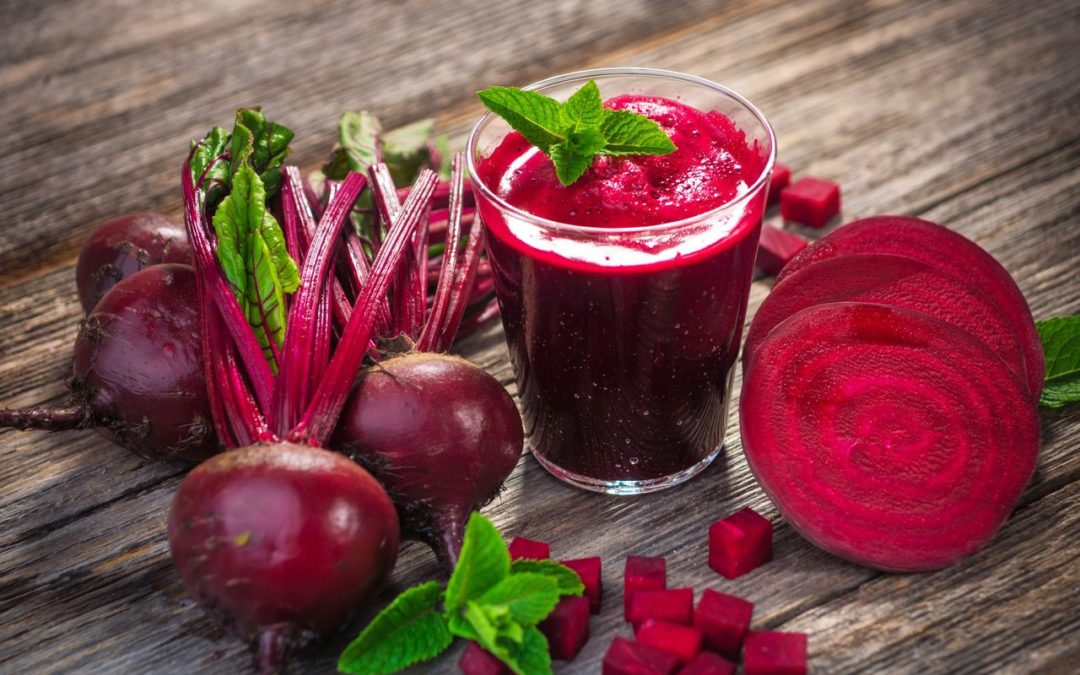
- Beetroot — the most studied source, and the base of most trial protocols
- Celery, lettuce, and cress
One tier down (100–250 mg/100 g): fennel, leek, parsley, endive, and Chinese cabbage.
Two practical notes from the research. First, dose and consistency matter: the beetroot juice trials that moved blood pressure typically delivered 300–500 mg of nitrate daily, with better results after two or more weeks of consistent intake — think a daily salad or beet serving, not an occasional one. Second, young greens punch above their weight nutritionally; I’ve written about why microgreens are one of the easiest upgrades to a midlife diet.
Pomegranate deserves its own mention because it works differently. Rather than supplying nitrate, pomegranate’s polyphenols protect the nitric oxide you already have: research by Nobel laureate Louis Ignarro found that pomegranate juice shields NO from oxidative destruction and enhances its biological action. I cover the fruit’s broader cardiovascular case in my pomegranate guide.
How to Increase Nitric Oxide Naturally
- Eat from the high-nitrate list daily. One generous serving of arugula, spinach, or beets most days is the foundation. This is the single most evidence-backed step on this list.
- Chew your vegetables — or at least keep them in your mouth. The conversion of nitrate to nitrite happens in your mouth, courtesy of your oral bacteria, so contact time matters. This is the science behind what I call the smoothie trick — chewing your drinks to boost nitric oxide — which I’ve written up separately.
- Rethink daily antiseptic mouthwash. The same oral bacteria are collateral damage of twice-daily antiseptic rinses — in the study above, a week of chlorhexidine mouthwash measurably raised blood pressure. Oral hygiene matters; routine antiseptic carpet-bombing may not. If a dentist has prescribed a rinse, follow their guidance — and mention it at your next visit.
- Move, most days. Exercise is the strongest stimulus for your internal eNOS pathway — the friction of blood moving faster across the endothelium directly signals it to produce more NO, and regular training improves vascular responsiveness even when started in midlife. It does not need to be heroic: brisk walking counts.
- Be honest about supplements. Beetroot powders and juices can work — they are simply concentrated delivery of the same nitrate found in food, and most positive trials used exactly that. L-citrulline, an amino acid that feeds the internal pathway, has reasonable supporting evidence. But no capsule replaces the dietary pattern, and anyone taking blood pressure medication or nitrate drugs (like nitroglycerin) should talk to their physician before adding a concentrated NO booster — the effects stack. For patients building a broader cardiovascular routine, my heart health protocols page lays out what I actually recommend and why.
FAQ: Nitric Oxide
What are the symptoms of low nitric oxide?
There is no routine clinical test, and low nitric oxide rarely announces itself directly. The signals are downstream and gradual: blood pressure creeping up over the years, reduced exercise tolerance, slower post-exercise recovery, and erectile difficulties in men. Because these are also signals of broader cardiovascular change, they warrant a conversation with your physician rather than self-diagnosis.
Does nitric oxide lower blood pressure?
The evidence says yes, modestly. Across 16 randomized trials, boosting nitric oxide through dietary nitrate lowered systolic blood pressure by an average of 4.4 mmHg. That is not a substitute for prescribed treatment — but as a dietary layer on top of it, the effect size is meaningful.
What foods are highest in nitric oxide?
Strictly speaking, none — foods supply nitrate, which your body converts to nitric oxide. The richest sources are arugula, spinach, beetroot, celery, lettuce and cress, all above 250 mg of nitrate per 100 g.
Is boosting nitric oxide safe?
Vegetable nitrate at dietary levels has a strong safety record, and the cured-meat nitrite concern is a different context entirely — vegetables come packaged with vitamin C and polyphenols that change the chemistry. The caution zone is concentrated supplements combined with blood pressure medication, PDE5 inhibitors, or prescribed nitrates. Stacking vasodilators can drop blood pressure further than intended, so clear supplements with your physician first.
How long does it take to raise nitric oxide levels?
Faster than almost anything else in nutrition. Blood nitrite peaks within about three hours of a nitrate-rich meal, and single-dose blood pressure effects appear the same day. The trials with the most consistent results, though, ran two weeks or longer — treat this as a daily habit, not a pre-event trick.
Key Takeaways
Nitric oxide is the molecule your blood vessels use to stay wide, flexible, and well-supplied — and production declines through midlife via well-mapped mechanisms. The response is not complicated: a daily serving of high-nitrate vegetables, regular movement, respect for the oral bacteria that run the conversion, and skepticism toward any product that promises more than a 4-mmHg kind of benefit. In cardiology, the interventions that work are usually the boring ones done consistently. This is one of them.
This article is for educational purposes and is not medical advice. Talk to your physician before changing medications, supplements, or your health routine — especially if you take blood pressure medication or prescribed nitrates.